


Introduction
When cargo is lost, damaged, or arrives with missing items, the first step is to document the problem, notify the insurer and carrier promptly, preserve the evidence, and follow the requirements of your cargo insurance policy. Acting quickly can make it easier to establish what happened and support your claim.
A cargo insurance claim is a formal request for compensation when insured goods suffer a covered loss or damage during transit. However, damaged cargo is not automatically covered. The insurer will consider the cause of the loss, policy terms, exclusions, insured value, transport documents, and supporting evidence before deciding the claim.
The process can vary depending on whether the shipment is moved by sea, air, road, or another transport method. In this guide, you’ll learn how to file a cargo insurance claim step by step, which documents you may need, how to handle visible and concealed damage, what can delay or affect a claim, and how the settlement process works.
Quick tip: If you have just discovered cargo damage or loss, don’t wait until you know the final financial impact before notifying the relevant parties. Start documenting the incident and check your policy requirements immediately.
What Is a Cargo Insurance Claim?
A cargo insurance claim is a formal request made to an insurer for compensation when insured goods are lost, damaged, or affected by another covered event during transit. The claim allows the insurer to review what happened and determine whether the loss falls within the policy’s coverage.
Filing a claim does not automatically mean the loss will be reimbursed. The insurer typically reviews the cause of loss, policy wording, exclusions, insured value, transport documents, and supporting evidence before deciding whether the claim is covered and how much may be payable.

For example, if goods arrive damaged, the claims process may involve notifying the insurer and carrier, documenting the damage, arranging a survey when required, submitting commercial and transport documents, and cooperating with the insurer during its assessment.
The exact cargo insurance claim process can vary based on the policy, type of cargo, transport method, and circumstances of the loss. That is why checking the policy requirements and reporting the incident promptly are important first steps.
When Should You File a Cargo Insurance Claim?
You should start the cargo insurance claim process as soon as you discover that cargo has been lost, damaged, or delivered with missing items. Do not wait until you have calculated the full financial loss before notifying the relevant parties. Early reporting gives the insurer and carrier an opportunity to investigate the incident and preserve important evidence.
Report the Loss or Damage Immediately
Contact your insurer or insurance broker as soon as the problem is identified. Your policy may specify a particular notification period, so check the policy wording rather than relying on a standard deadline.
You should also notify the carrier in writing and keep a copy of the communication. This step is an important part of the claim procedure for cargo insurance, particularly when the carrier may be responsible for the loss or damage.
What If the Damage Is Discovered After Delivery?
Not all cargo damage is visible when a shipment is delivered. If you discover concealed damage after opening the package or container, document it immediately and notify the relevant parties. This can be important when filing a cargo damage claim because the condition of the shipment and packaging may help establish when and how the damage occurred.
Avoid throwing away damaged goods or packaging until the insurer or appointed surveyor confirms that they can be disposed of or handled differently.
Why Acting Quickly Matters
Prompt action helps preserve evidence that may support your shipping insurance claim, including:
- Damaged packaging and cargo
- Container and seal condition
- Delivery receipts and exception remarks
- Photos and videos of the shipment
- Carrier correspondence
- Survey findings
The sooner these details are recorded, the easier it can be to establish what happened and support your claim. This is particularly important in cargo claims in shipping, where evidence may be needed from multiple parties involved in transporting and handling the goods.
How to File a Cargo Insurance Claim: Step-by-Step Process
The cargo insurance claim process generally involves notifying the insurer and carrier, preserving evidence, arranging an inspection when required, submitting supporting documents, and cooperating with the insurer’s assessment. The exact claim procedure for cargo insurance can vary according to the policy and circumstances of the loss.
Step 1: Notify Your Insurer or Insurance Broker
As soon as you discover cargo loss or damage, notify your cargo insurance broker. Provide basic details about the shipment, including the policy or certificate number, transport method, shipment reference, and a brief description of what happened.
If your policy or broker specifies a notification period, follow that requirement carefully. Early notification allows the insurer to determine the next steps and whether a survey or further investigation is necessary.
Step 2: Notify the Carrier in Writing
Notify the shipping line, airline, road carrier, freight forwarder, or other responsible transport party in writing. Keep a copy of your notice and any response you receive.
For a cargo damage claim, make the damage clear on the delivery receipt or other relevant transport record whenever possible. If damage is concealed and discovered after delivery, notify the carrier as soon as it is identified and follow the applicable transport terms.
This carrier notification is important because the insurer may need to investigate whether another party is responsible for the loss and may later seek recovery from that party.
Step 3: Preserve the Cargo and Evidence
Do not repair, dispose of, or alter the damaged cargo unless you have received appropriate instructions. Preserving the physical evidence can help establish the cause and extent of the loss during the cargo claims insurance assessment.
Take clear photos and videos of the damaged cargo, packaging, container, seals, and surrounding condition. Keep the original packaging and damaged goods available for inspection.
Step 4: Arrange a Survey When Required
For certain losses, the insurer may appoint an approved surveyor to inspect the cargo and determine the nature and extent of the damage.
Be available during the inspection and provide the surveyor with relevant shipment records and evidence. The resulting survey report can become an important part of the shipping insurance claim assessment.
Step 5: Review Your Cargo Insurance Policy
Before submitting the complete claim, review the policy wording, insured risks, exclusions, deductibles, and insured value.
Coverage depends on the terms of the policy and the cause of the loss. For example, marine cargo policies may use different Institute Cargo Clauses, such as ICC (A), ICC (B), or ICC (C), which provide different levels of coverage.
Step 6: Complete the Claim Form and Submit Documents
Complete the insurer’s cargo claim form and provide the supporting documentation requested. This may include the insurance certificate, commercial invoice, packing list, bill of lading or air waybill, delivery records, carrier correspondence, photographs, and survey report.
Providing a complete document set can reduce unnecessary back-and-forth during the cargo insurance claim procedure.
Step 7: Cooperate With the Claim Assessment
The insurer reviews the available evidence and determines whether the reported loss falls within the policy coverage. Additional information or documents may be requested during this stage.
Responding promptly to these requests helps keep the cargo claims process moving and gives the insurer the information needed to assess the loss.
Step 8: Settlement and Payment
If the claim is approved, the insurer determines the payable amount according to the policy terms and the insured value agreed when the coverage was arranged.
Once the settlement is finalized, payment is generally made to the insured according to the insurer’s settlement procedure. The insurer may also retain rights to recover the loss from a responsible carrier or other third party.
Plan Coverage Before Your Next Shipment
Enter your shipment value, transport mode, and cargo type to estimate your cargo insurance premium and understand your potential coverage needs.
Documents Required for a Cargo Insurance Claim
The documents required for a cargo insurance claim depend on the type of loss, transport mode, and policy terms. However, insurers commonly need evidence that establishes what was shipped, how it was transported, what happened to the cargo, and the value of the loss.
Preparing these documents early can make the cargo claims process more organized and reduce delays caused by missing information.
1. Insurance Documents
You may need:
- Original Certificate of Insurance
- Completed cargo insurance claim form
- Policy or certificate number
- Letter of Subrogation, where required after settlement
The certificate helps the insurer identify the applicable cargo insurance coverage and insured shipment.
2. Commercial Documents
- Commercial invoice
- Packing list
- Purchase order or sales contract
- Weight and measurement certificate, where applicable
- Certificate of origin, where applicable
For a cargo damage claim, the invoice and packing list can also help establish the quantity and value of the affected goods.
These documents help establish the cargo’s description and value:
3. Transport Documents
The relevant transport records depend on how the shipment moved:
- Bill of Lading (B/L) or sea waybill for ocean freight
- Air Waybill (AWB) for air freight
- Delivery receipt or proof of non-delivery
- Equipment Interchange Receipt (EIR), where applicable
- Outturn reports or tally sheets for certain sea shipments
- Inland forwarding or transport contracts for some road shipments
4. Damage and Loss Evidence
Evidence showing the condition and circumstances of the loss can be particularly important during a shipping insurance claim. Keep:
- Photos and videos of the damaged cargo
- Photos of packaging and containers
- Container and seal details
- Delivery receipts showing exception remarks
- Written notice sent to the carrier
- Carrier’s response or correspondence
- Survey report, when a survey is conducted
- Other records related to the incident
What If a Bill of Lading Is Not Available?
A missing Bill of Lading does not necessarily mean you cannot submit a claim. Depending on the shipment, alternative records such as an inland forwarding contract, final delivery receipt, written notice to the inland carrier, and related correspondence may help establish the movement and delivery of the cargo.
The insurer may request additional documents depending on the circumstances. Therefore, the safest approach is to follow the requirements in your cargo insurance policy and provide complete, consistent evidence supporting the loss.
How to Handle Concealed Cargo Damage
Concealed damage occurs when cargo appears intact when it is delivered, but damage is discovered later after the packaging, container, or shipment is opened. This situation can make a cargo damage claim more difficult because the damage may not have been recorded on the delivery receipt.
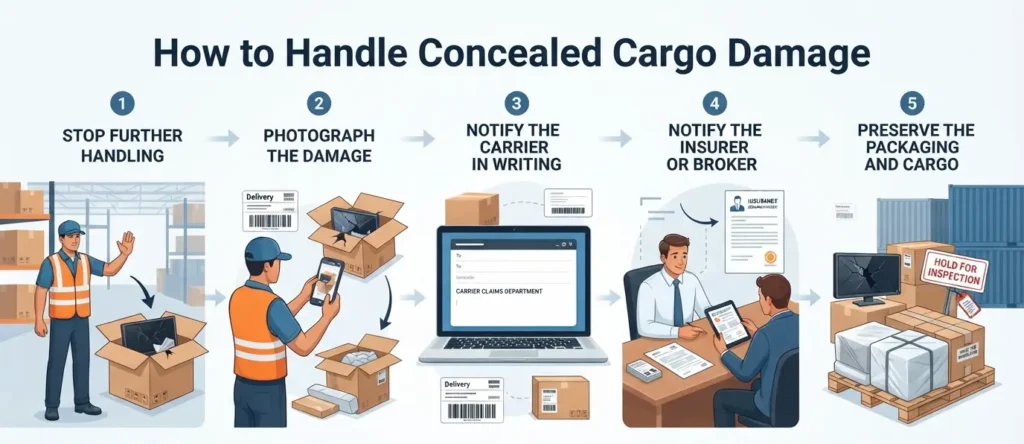
If you discover concealed damage, take the following steps as soon as possible:
1. Stop Further Handling
Avoid using, repairing, repacking, or disposing of the damaged goods until you receive instructions from the insurer, broker, or appointed surveyor. Further handling can make it harder to establish the original condition of the cargo.
2. Photograph the Damage
Take clear photographs and videos showing:
- The damaged goods
- Inner and outer packaging
- Cartons, pallets, or crates
- Container condition and seals, where applicable
- Labels and shipment markings
- Any signs of impact, water ingress, crushing, or tampering
Keep the original files where possible, including their dates and relevant shipment references.
3. Notify the Carrier in Writing
Inform the carrier promptly after discovering the damage. For concealed damage, written notification is particularly important because the carrier may need an opportunity to inspect the shipment.
Keep copies of emails, letters, delivery records, and the carrier’s response as part of your cargo claims insurance documentation.
4. Notify the Insurer or Broker
Report the loss to your insurer or insurance broker and explain that the damage was discovered after delivery. Follow the notification requirements in your cargo insurance policy, as applicable deadlines can vary.
The insurer may arrange a survey or request additional evidence before assessing the shipping insurance claim.
5. Preserve the Packaging and Cargo
Do not throw away the packaging simply because the shipment has already been delivered. Damaged cartons, pallets, wrapping, seals, and other materials may provide useful evidence about how the loss occurred.
The key principle is simple: document concealed damage immediately, preserve the evidence, and follow the notification requirements in your policy and transport contract. This can provide stronger support for a cargo insurance claim during the subsequent investigation.
How Long Does a Cargo Insurance Claim Take?
A cargo insurance claim can take anywhere from several weeks to several months to settle. There is no single timeline that applies to every claim. Straightforward claims with complete documentation and clear evidence may be resolved relatively quickly, while claims involving disputed liability, third-party recovery, salvage, or General Average can take considerably longer.
Typical Cargo Insurance Claim Timeline
Stage | What Usually Happens |
Immediately after discovery | Notify the insurer or broker and carrier, document the loss, and preserve the cargo and packaging. |
First few days | The insurer may review the initial information and arrange a survey or further investigation. |
First 1–4 weeks | Commercial, insurance, transport, and damage-related documents are collected and reviewed. |
Following weeks or months | The insurer assesses coverage, cause of loss, liability, and the amount payable. |
Settlement stage | Once the claim is approved and the settlement is agreed, payment is processed according to the insurer’s procedure. |
A well-documented claim may move through the cargo claims process more efficiently because the insurer has the evidence needed to assess the loss. Missing documents, unclear damage, delayed responses, or disagreements over liability can extend the process.
What Can Delay a Cargo Claim?
Several factors can increase the time required to resolve a shipping insurance claim, including:
- Missing invoices, packing lists, or transport documents
- Delayed carrier correspondence
- Difficulty arranging a cargo survey
- Unclear cause of damage or loss
- Disagreement about policy coverage
- Disputed carrier liability
- Salvage or disposal issues
- Third-party recovery proceedings
- General Average
- Legal or contractual disputes
Are There Deadlines for Filing a Claim?
Do not assume that every cargo insurance claim has the same filing deadline. Notice requirements can come from the insurance policy, transport contract, applicable law, or other relevant terms.
Some policies may require prompt notification after the loss is discovered, while carriers and transport conventions can have their own notice or limitation requirements. Therefore, check your cargo insurance policy and transport documents immediately after discovering a loss.
The safest approach is to notify the relevant parties promptly, even when the full extent or financial value of the damage has not yet been established.
Why Do Cargo Insurance Claims Get Delayed or Rejected?
A cargo insurance claim may be delayed when the insurer does not have enough information to establish the cause, extent, or value of the loss. A claim can also be declined when the circumstances fall outside the policy’s coverage or an applicable exclusion.
Not every delay means the claim will be rejected. In many cases, the issue is simply incomplete documentation or the need for additional investigation.
Common Reasons for Delays
The cargo insurance claim process can take longer when:
- Required documents are missing or inconsistent
- Damage is reported late
- The carrier has not been notified in writing
- Photos or other evidence are insufficient
- A survey is required but has not yet been completed
- The cause of loss is unclear
- The insurer requests additional information
- Carrier liability or third-party recovery is disputed
- Salvage or disposal arrangements have not been resolved
Common Reasons a Claim May Not Be Covered
A shipping insurance claim may be declined if the loss results from an excluded cause or does not fall within the insured risks. Depending on the policy wording, examples can include:
- Willful misconduct
- Inherent vice or the natural characteristics of the goods
- Ordinary wear and tear
- Certain losses caused by inadequate packaging
- Pure financial losses resulting from delay
- War or strikes where the relevant risks were not insured
The exact exclusions depend on the policy and applicable clauses, so these examples should not be treated as a universal list.
How to Reduce Unnecessary Claim Problems
You can make the claim procedure for cargo insurance more organized by:
- Reporting the loss promptly.
- Notifying the carrier in writing.
- Taking detailed photographs and videos.
- Preserving damaged goods and packaging.
- Keeping all transport and commercial records.
- Following the insurer’s survey instructions.
- Responding promptly to requests for additional information.
- Reviewing your policy’s coverage and exclusions before assuming a loss is insured.
The key is to provide consistent evidence showing what happened, when it happened, what was damaged or lost, and the value of the affected cargo. This gives the insurer a clearer basis for assessing the cargo claims process.
What Is Usually Not Covered by Cargo Insurance?
Cargo insurance coverage depends on the specific policy, insured risks, exclusions, and applicable clauses. A loss is not automatically covered simply because the cargo was damaged or lost during transit.
Common exclusions or limitations in cargo insurance may include the following:
1. Willful Misconduct
Loss caused intentionally by the insured may be excluded. This is different from ordinary negligence, so the circumstances and policy wording need to be considered when assessing a cargo insurance claim.
2. Inherent Vice or Natural Characteristics of the Goods
Some goods can deteriorate because of their own natural properties rather than an external transit event. Examples may include fruit ripening, certain food spoilage, or metals developing rust under particular conditions.
Whether such deterioration is covered depends on the policy and the actual cause of loss.
3. Ordinary Wear and Tear
Normal deterioration, gradual damage, or wear that occurs as part of handling or the ordinary nature of the goods may not be covered under standard cargo insurance terms.
4. Inadequate Packaging
Cargo may be excluded when the loss results from packaging or preparation that was insufficient for the expected journey. For example, fragile goods packed without appropriate internal protection may be vulnerable to damage during normal handling.
Packaging requirements should therefore be considered when arranging cargo insurance coverage.
5. Delay and Consequential Losses
A cargo policy may not cover financial losses caused solely by delay, such as lost sales, missed contracts, or changes in market prices, unless specific coverage has been provided.
For example, if a shipment arrives late but the goods themselves are undamaged, the resulting loss of a customer order may not be recoverable under standard cargo insurance.
6. War and Strikes
War, strikes, riots, and related risks may require specific additional clauses or coverage. They should not be assumed to be included in every cargo insurance policy.
Always Check the Policy Wording
These exclusions are general examples, not a universal list. Different policies can provide different levels of protection, including different Institute Cargo Clauses and additional extensions.
Before submitting a cargo damage claim, review the applicable policy wording to understand the insured risks, exclusions, deductibles, and conditions that apply to your shipment. This helps set realistic expectations during the cargo insurance claim process.
Cargo Insurance Claim Checklist
Before submitting a cargo insurance claim, review the following checklist to make sure you have reported the incident, preserved the evidence, and gathered the key documents.
Before You Submit Your Claim
- Notify the insurer or insurance broker promptly.
- Notify the carrier or responsible transport party in writing.
- Record the loss, shortage, or damage with photos and videos.
- Photograph the cargo, packaging, container, and seals where relevant.
- Keep damaged goods and packaging available for inspection.
- Record visible damage or shortage on the delivery receipt when possible.
- Notify the carrier promptly if concealed damage is discovered after delivery.
- Arrange a survey if requested by the insurer.
- Locate the original Certificate of Insurance.
- Prepare the commercial invoice and packing list.
- Gather the Bill of Lading, sea waybill, Air Waybill, or relevant road transport document.
- Keep delivery receipts, EIRs, tally sheets, or other applicable transport records.
- Save all correspondence with the carrier, insurer, broker, surveyor, and other relevant parties.
- Complete the insurer’s claim form accurately.
- Review the policy’s coverage, exclusions, deductibles, and notice requirements.
- Respond promptly if the insurer requests additional information.
Quick Rule to Remember
Notify → Document → Preserve → Survey → Submit → Cooperate
Following these steps can help keep the cargo claims process organized and provide the evidence needed to assess a cargo damage claim or loss. However, a complete checklist does not guarantee coverage; the final assessment depends on the applicable cargo insurance policy and the circumstances of the loss.
Also Read: What to Do If Your Cargo Insurance Claim in Singapore Is Rejected




11 Responses