


Introduction
When a shipment is damaged, lost, or stolen, marine cargo insurance can help cover an eligible financial loss. But the amount you receive after a claim depends on more than the policy’s coverage limit. One important factor is the deductible in marine insurance.
A deductible is the portion of a covered loss that you agree to bear before the insurer pays the remaining amount, subject to the terms of your policy. For example, if an approved cargo loss is $10,000 and the applicable deductible is $1,000, the insurer would generally pay $9,000.
The deductible can also affect your marine cargo insurance cost. A higher deductible may reduce the premium because your business agrees to retain more of the potential loss. A lower deductible can reduce your out-of-pocket expense when a claim occurs, but it may come with a higher premium.
For businesses shipping through Singapore and other Asian markets, understanding the deductible helps you choose suitable coverage and avoid unexpected claim costs.
What Is Deductible in Marine Insurance?
A Deductible in Marine Insurance is the amount of a covered loss that the cargo owner agrees to pay before the insurer pays the remaining eligible amount. It is stated in the marine cargo insurance policy and can be a fixed amount or calculated using a percentage, depending on the policy terms.
The deductible is therefore an important part of marine cargo insurance coverage. It affects how much you may need to pay yourself when a loss occurs and can also influence your overall marine cargo insurance cost.
Before purchasing a policy, cargo owners should check the deductible amount, how it is calculated, and whether it applies per shipment, per claim, or under specific policy conditions.
Why Deductible in Marine Insurance Exists
The Deductible in Marine Insurance is not added randomly. It serves an important purpose in every marine cargo insurance policy. It helps create balance between the insurer and the insured while keeping the system fair and practical.
1):- Reduces Minor Claim Frequency
One major reason for having a Deductible in Marine Insurance is to reduce small and frequent claims. If there were no deductibles in marine insurance, businesses might file claims for minor damages, which would increase administrative costs and premiums for everyone.
2):- Encourages Responsible Cargo Handling
When cargo owners know they must pay part of the loss, they handle shipments more carefully. This includes better packaging, proper documentation, and choosing reliable transport partners. The Deductible in Marine Insurance encourages proactive risk management.
3):- Helps Lower Premium Cost
A higher Deductible in Marine Insurance often results in a lower marine cargo insurance cost. Since you are agreeing to bear part of the risk, the insurer may offer reduced premiums. This makes deductible insurance a strategic financial decision.
4):- Supports Financial Planning
Understanding deductible insurance helps businesses plan cash flow better. Instead of unexpected full losses, you know exactly how much you may need to pay in case of a marine cargo insurance claim.
In short, the Deductible in Marine Insurance protects both the insurer and the policyholder while keeping marine cargo insurance coverage sustainable and affordable.
Types of Deductibles in Marine Insurance
There are different types of Deductible in Marine Insurance, and each one works differently depending on your marine cargo insurance policy. Understanding these deductibles in marine insurance helps you select the right structure based on your shipment value and risk level.
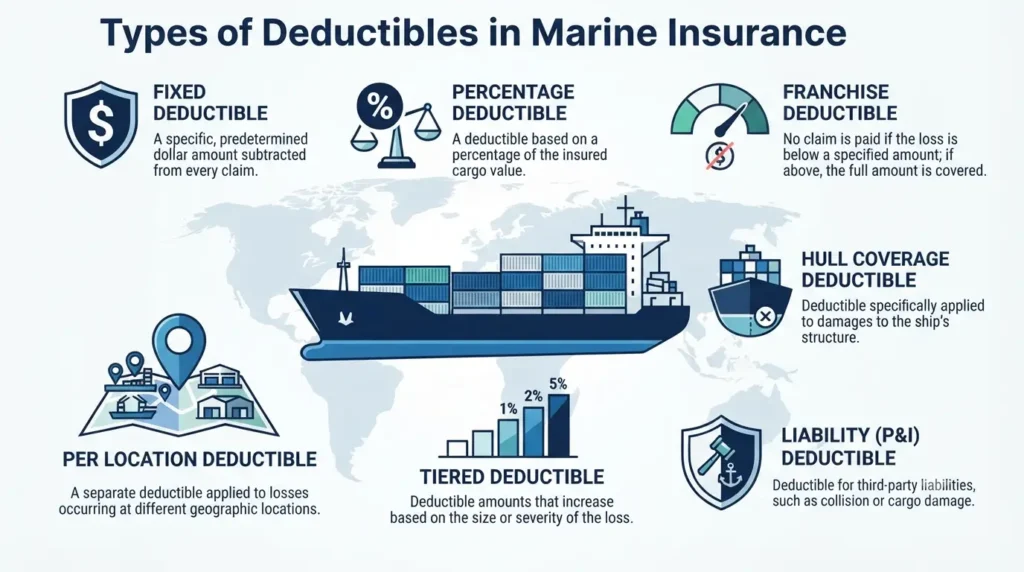
1):- Fixed Deductible
A fixed deductible is a pre-decided amount applied to every claim, regardless of the total loss.
Example:
If your claim amount is $15,000 and your deductible is $1,000, the insurer will pay $14,000 under your marine cargo insurance coverage.
This type is simple, predictable, and easy to manage.
2):- Percentage Deductible
In this case, the deductible is calculated as a percentage of the insured cargo value or claim amount.
Example:
If your cargo is insured for $100,000 and the deductible is 5%, you will pay $5,000 before the insurer settles the remaining amount.
This option is common in high-value shipments and directly affects your overall marine cargo insurance cost.
3):- Franchise Deductible
A franchise structure works differently. If the loss is below a certain threshold, the insurer does not pay anything. But if the loss exceeds that limit, the claim may be paid in full without deduction.
This is suitable for businesses that want protection mainly against major losses.
4):- Hull Coverage Deductible
Hull coverage protects the vessel’s structure and machinery. The deductible for hull insurance can be either fixed or percentage-based and is separate from cargo coverage.
5):- Liability (P&I) Deductible
This applies to third-party claims, especially for freight forwarders and vessel operators. The deductible is usually applied per incident involving property damage or bodily injury.
6):- Tiered Deductible
In a tiered system, the deductible varies depending on the size of the claim. Smaller claims may have lower deductibles, while larger claims may carry higher amounts.
7):- Per Location Deductible
For shipments moving through high-risk routes, insurers may apply higher deductibles. For example, piracy-prone regions or extreme weather zones can increase financial exposure under a marine cargo insurance policy.
How Deductible in Marine Insurance Works
A Deductible in Marine Insurance is generally applied to an eligible covered loss before the insurer considers the remaining amount for settlement. However, the exact calculation depends on how the deductible is defined in the policy.
How Is Marine Insurance Deductible Calculated?
Consider a simple example:
- Covered loss: $10,000
- Applicable deductible: $1,000
- Amount remaining: $9,000
If the claim is covered and approved for $10,000, the insurer would generally consider $9,000 for payment after applying the deductible. The final settlement can still depend on the policy limit, exclusions, valuation, evidence of loss, and other applicable terms.
What If the Deductible Is a Percentage?
The calculation depends on the basis stated in the policy. A percentage may be applied to the insured value, the amount of the loss, or another specified amount.
For example, if a policy applies a 2% deductible to an insured value of $100,000, the deductible would be $2,000.
This is why cargo owners should not look at the percentage alone. Always confirm the calculation basis in the marine cargo insurance policy.
What Happens If the Loss Is Smaller Than the Deductible?
If a covered loss is below the applicable deductible, there may be no amount payable under the policy.
For example, a shipment suffers a $700 covered loss and has a $1,000 deductible. Because the loss is below the deductible, the business may need to absorb the entire $700, depending on the policy structure.
This matters for businesses that handle frequent shipments because repeated small losses may fall within the deductible.
Is the Deductible Always the Same?
Not necessarily. Deductible terms can vary by policy, cargo, route, coverage section, and type of loss. Some policies may also contain special conditions or different deductibles for specific risks.
Before relying on a particular deductible amount, check:
- What amount or value is used to calculate it?
- Does it apply per shipment or per claim?
- Are there different deductibles for specific risks?
- Does it apply to every covered loss?
- Are there minimum or special deductible conditions?
Understanding these details before a marine cargo insurance claim can help you estimate your potential out-of-pocket exposure and avoid unexpected costs.
How Does a Deductible Affect Marine Cargo Insurance Claims?
A deductible directly affects the amount your business may receive from an approved marine cargo insurance claim. The higher the applicable deductible, the larger the portion of the covered loss your business must retain before the insurer considers the remaining amount for settlement.
1. It Reduces the Amount Considered for Payment
Suppose your cargo suffers a covered loss of $20,000 and the applicable deductible is $2,000.
The calculation would generally be:
$20,000 covered loss − $2,000 deductible = $18,000
The insurer would generally consider $18,000 for payment, subject to the policy terms, exclusions, limits, and claim assessment.
2. It Increases Your Out-of-Pocket Exposure
The deductible represents the part of the covered loss your business agrees to retain.
For example, an importer receives a shipment worth $80,000 and later discovers a covered loss of $6,000. With a $2,000 deductible, the business would generally absorb the first $2,000, while the remaining $4,000 could be considered for settlement under the policy.
This is why the deductible should be affordable even when a large shipment is involved.
3. It Can Affect Your Insurance Premium
A higher deductible can sometimes reduce your marine cargo insurance cost because your business is accepting more of the potential loss. A lower deductible can provide greater protection against smaller losses but may result in a higher premium.
The actual premium difference depends on factors such as cargo type, shipment value, route, coverage, claims history, and underwriting terms.
4. It Matters Most for Smaller Losses
The deductible becomes particularly important when the loss is close to the deductible amount.
Scenario: A business ships 50 orders in a month, and one shipment has a covered loss of $1,200. If the applicable deductible is $1,000, only $200 remains after applying the deductible, subject to the policy terms.
For businesses that experience frequent smaller losses, choosing a deductible simply because it produces a lower premium may not always be the most practical option.
5. The Deductible Does Not Replace the Claim Process
Having a deductible does not mean a claim is automatically paid after subtracting the deductible. The loss must still fall within the policy’s coverage, and the insurer may require supporting documents and evidence before determining the eligible claim amount.
Cargo owners should therefore understand both the marine cargo insurance coverage and the deductible conditions before a loss occurs.
What Factors Should You Consider When Choosing a Deductible?
The right deductible depends on how much risk your business can comfortably retain. Instead of choosing the lowest or highest amount simply to change your premium, consider your cargo value, shipment frequency, routes, and ability to absorb an unexpected loss.
1. Your Financial Capacity
Start with a simple question: How much could your business comfortably pay if a covered loss occurred tomorrow?
A deductible should not be so high that paying it would disrupt normal operations, supplier payments, or cash flow.
2. The Value of Your Cargo
Cargo value should play an important role in your decision. A $5,000 deductible may have a very different financial impact on a $20,000 shipment than on a $500,000 shipment.
For high-value goods, review whether the deductible leaves your business with an acceptable level of retained risk.
3. How Frequently You Ship
Shipment frequency also matters. A company making a few high-value shipments each year may approach deductibles differently from a distributor moving hundreds of shipments every month.
Scenario: A business ships 100 consignments annually with an average value of $10,000. If minor losses occur several times a year, a high deductible could mean the business absorbs a significant amount of those smaller losses itself.
4. Your Cargo and Transit Risks
Different goods and transportation routes can carry different levels of exposure. Consider how your cargo moves and what risks it may encounter during transit, including handling, weather, theft, or other covered risks.
Businesses moving goods between Singapore, Thailand, Malaysia, Cambodia, China, and India should review whether their policy contains route-specific conditions or deductible provisions.
5. Your Coverage Structure
Do not look at the deductible separately from the coverage. Review how it interacts with your marine cargo insurance coverage, insured value, exclusions, limits, and other policy conditions.
If your business also uses other forms of cargo or logistics insurance, such as freight forwarder liability or parcel insurance, remember that those products may have different terms and deductible structures.
6. The Premium Savings
A higher deductible may reduce your marine cargo insurance cost, but the premium saving should be compared with the additional risk your business is accepting.
For example, saving $500 in annual premium may not be worthwhile if increasing the deductible means your business could face an additional $5,000 expense after a covered loss.
7. Your Long-Term Risk Strategy
Think beyond the next premium payment. The right deductible should fit your broader approach to risk management, cash reserves, cargo handling, and claims.
A practical rule: choose a deductible that provides meaningful insurance protection while leaving your business financially comfortable with the portion of loss it has agreed to retain.
Before finalizing a policy, compare the deductible and premium together rather than evaluating either one in isolation.
How Can You Manage Your Marine Insurance Deductible?
Managing your deductible starts before a shipment is lost or damaged. By reviewing the policy, keeping accurate records, and maintaining a reserve for potential losses, cargo owners can make the marine cargo insurance claim process more predictable.
1. Read the Deductible Clause Carefully
Do not look only at the deductible amount. Check how it is calculated and when it applies.
Confirm whether the deductible is:
- A fixed amount or percentage
- Based on the loss, insured value, or another amount
- Applied per shipment, claim, or occurrence
- Different for particular cargo, routes, or risks
These details can significantly affect your out-of-pocket cost.
2. Keep Complete Shipment Records
Good documentation can make a claim easier to assess. Keep relevant records such as invoices, packing lists, shipping documents, inspection reports, photographs, and delivery records.
Scenario: If a $25,000 shipment arrives damaged, having photographs taken at delivery and complete packing and invoice records can help establish what was shipped, its value, and the condition in which it arrived.
3. Improve Packaging and Handling
Insurance does not replace good risk management. Proper packaging, labeling, loading, and handling can reduce the likelihood of cargo damage.
Fewer preventable losses can also reduce the number of situations where your business has to absorb a deductible.
4. Maintain a Deductible Reserve
Consider keeping funds available specifically for potential retained losses.
For example, if your policy has a $3,000 deductible and your business regularly ships high-value cargo, maintaining at least enough accessible cash to cover that amount can prevent a claim from creating an unexpected cash-flow problem.
5. Compare Deductible Options
When reviewing marine cargo insurance cost, compare the premium alongside the deductible.
A lower premium is not automatically the better option if it requires your business to accept a much larger loss whenever a claim occurs. Ask how different deductible levels change the premium and then consider whether the potential saving justifies the additional risk.
6. Review Your Policy as Your Business Changes
Your ideal deductible may change as your shipment volume, cargo values, routes, or financial capacity change.
A business that starts with $10,000 shipments may need a different risk structure after it begins moving $100,000 consignments.
Regularly reviewing your marine cargo insurance policy helps ensure that the deductible still matches your current business exposure.
The goal is simple: use the deductible as part of a wider risk-management strategy, rather than treating it as just another number on an insurance quote.
What Common Mistakes Should Cargo Owners Avoid?
Cargo owners often focus on the coverage limit and premium when buying marine insurance, but the deductible can be just as important. Overlooking its terms can lead to unexpected costs when a loss occurs.
1. Looking Only at the Premium
Choosing a policy because it has the lowest marine cargo insurance cost can be misleading. A lower premium may come with a higher deductible, leaving your business responsible for a larger portion of a covered loss.
Always compare the premium, coverage, deductible, exclusions, and limits together.
2. Assuming the Deductible Is Always Fixed
A deductible may be fixed or percentage-based, and the calculation can depend on the policy wording.
For example, a 2% deductible could produce a $2,000 deductible when applied to a $100,000 insured value. But if the policy uses a different calculation basis, the result could be different.
Never assume what the percentage means. Check the actual policy clause.
3. Choosing a High Deductible Just to Save Money
A higher deductible can reduce premiums, but it also increases your retained risk.
Scenario: A business saves $800 per year by increasing its deductible from $1,000 to $5,000. If a covered loss of $6,000 occurs, the business may have to absorb $5,000 instead of $1,000, subject to the policy terms.
The premium saving may not justify that additional exposure.
4. Ignoring Route-Specific Conditions
Cargo moving through different countries or trade routes may face different risks and policy conditions. Businesses operating across Singapore, Thailand, Malaysia, Cambodia, China, and India should check whether any special deductible provisions apply to their routes or cargo.
5. Assuming Every Loss Is Covered
A deductible only applies after determining that a loss falls within the policy’s coverage. It does not turn an excluded loss into a covered one.
Before filing a marine cargo insurance claim, review the relevant coverage, exclusions, conditions, and documentation requirements.
6. Not Keeping Enough Cash for the Deductible
A business may have sufficient funds to pay its annual premium but still struggle to cover a large deductible after a major loss.
If your deductible is $5,000, for example, maintaining access to at least that amount can help prevent a covered incident from creating an immediate cash-flow problem.
7. Ignoring Changes in Shipment Value
Your deductible should continue to make sense as your business grows. If your average shipment value increases from $20,000 to $150,000, the risk retained by the business may also change.
Review your marine cargo insurance policy whenever your shipment values, routes, cargo types, or shipping volume change.
Avoiding these mistakes can help cargo owners choose a deductible that matches their actual risk instead of simply choosing the cheapest insurance option.
Also Read: Marine Cargo Insurance Myths and Facts: What Every Shipper Should Know



One Response