

Introduction
To get high value parcel insurance before shipping valuable goods, determine the shipment’s actual value, identify the cargo and transport route, compare coverage and exclusions, prepare proof of value, and purchase the policy before the parcel enters transit.
The need for protection is becoming more relevant as parcel shipping continues to grow. Pitney Bowes projected that global parcel volume could exceed 256 billion parcels annually by 2027, reflecting the increasing scale of goods moving through parcel networks.
For businesses and individuals shipping expensive electronics, jewellery, luxury goods, artwork, collectibles, or other high-value items, standard carrier liability may not provide protection equal to the shipment’s full value. Shipping insurance for expensive items can provide additional financial protection for covered transit risks, depending on the policy terms.
This guide explains how to get insurance for valuable parcels, what information you need for a quote, what parcel insurance coverage may include, how parcel insurance cost is determined, and what to check before your shipment is dispatched.
What Is High Value Parcel Insurance?
High value parcel insurance is transit insurance designed to protect valuable goods against covered financial losses while they are being shipped. Depending on the policy, protection may apply to risks such as accidental damage, theft, or loss during transit.
There is no single universal value that automatically makes a parcel “high value.” The threshold can depend on the type of goods, their actual value, the carrier’s liability limits, the route, and the financial impact of losing or damaging the shipment.

High Value Parcel Insurance vs. Carrier Liability
Carrier liability and parcel insurance are not necessarily the same. Carrier liability is the carrier’s contractual or legally applicable responsibility for a shipment, while insurance provides protection according to the specific risks, limits, exclusions, and conditions stated in the insurance policy.
For an expensive shipment, review both before dispatch rather than assuming that the carrier will reimburse the full value of the goods.
How Do You Get High Value Parcel Insurance Before Shipping?
Getting high value parcel insurance usually involves eight steps: establish the shipment value, identify the goods and route, determine the required coverage, compare policy terms, prepare supporting documents, declare the value accurately, purchase the policy before dispatch, and retain the insurance records.
Step | What to Do | Why It Matters |
1. Determine the shipment value | Establish the actual value of the goods using invoices, receipts, or other supporting documents. | Helps determine the appropriate coverage amount. |
2. Identify the goods | Provide details about the item, quantity, condition, and packaging. | Some goods may have specific eligibility or coverage requirements. |
3. Provide the shipping route | Give the origin, destination, and countries the parcel will pass through when applicable. | Risk and coverage can vary by route and destination. |
4. Confirm the transport method | Specify whether the parcel will move by courier, air, road, or another transport method. | Different transit methods can involve different risks and policy terms. |
5. Check the required coverage | Review the risks you want covered, coverage limits, deductibles, and exclusions. | Helps prevent gaps between the policy and your actual exposure. |
6. Prepare supporting documents | Keep invoices, purchase receipts, packing details, and shipping information available. | Insurers may require proof of value and shipment details for underwriting or claims. |
7. Declare the value accurately | State the shipment’s actual insurable value rather than an artificially reduced amount. | Underdeclaring can reduce the amount recoverable under applicable policy terms. |
8. Purchase before dispatch | Arrange the insurance and confirm the policy is active before the parcel enters transit. | Buying early helps ensure the shipment is covered from the applicable start of transit. |
Quick Example
Suppose a Singapore business is sending SGD 25,000 worth of electronic equipment to India. Before dispatch, the business would provide the cargo value, item details, origin and destination, transport method, and supporting invoice. It could then compare available high value shipping insurance options and confirm the coverage and exclusions before purchasing the policy.
The exact information and underwriting requirements can vary by insurer, cargo type, route, and policy. Always confirm when coverage begins and what conditions apply before handing the parcel to the carrier.
What Information Do You Need to Get a High Value Parcel Insurance Quote?
To get a high value parcel insurance quote, you typically need the shipment value, cargo description, origin, destination, transport method, shipping date, and supporting documents. Insurers may request additional details depending on the item, route, value, and coverage required.
Information | What to Provide |
Shipment value | The actual value of the goods you want to insure. |
Cargo details | Item type, quantity, condition, and any relevant product specifications. |
Origin and destination | Where the parcel starts and where it will be delivered. |
Transport method | Courier, air freight, road transport, or another applicable method. |
Shipping date | The planned date the shipment will enter transit. |
Packaging details | How the goods are packed and protected for transportation. |
Commercial invoice | An invoice or other document supporting the declared value, when available. |
Previous shipping information | Details of the carrier or shipment may be needed for certain policies. |
Providing accurate information from the beginning can help the insurer assess the shipment and determine applicable parcel insurance coverage, limits, exclusions, and premium.
Example
If you are shipping a SGD 50,000 medical device from Singapore to India, the quote request should clearly state the equipment’s value, cargo description, route, transport method, planned shipping date, and available proof of value. Providing these details upfront can make the coverage assessment more straightforward.
Check Your High Value Parcel Insurance Cost
Estimate your potential insurance premium using your shipment value, transport mode, and cargo type. Get a clearer idea of your potential parcel insurance cost before arranging coverage.
What Does High Value Parcel Insurance Cover?
High value parcel insurance can protect valuable shipments against specific risks that occur during transit, but the exact protection depends on the insurer and policy. Coverage may include loss, theft, accidental damage, and other insured transit events.
Common areas of parcel insurance coverage may include:
- Loss in transit: Protection when an insured parcel is lost during the covered journey.
- Theft: Coverage for theft when it is an insured risk under the policy.
- Accidental damage: Financial protection for physical damage caused by a covered transit event.
- Transport accidents: Some policies may cover damage or loss resulting from an accident involving the vehicle or transport method.
- Fire: Loss or damage caused by fire may be covered when included in the policy.
- Weather-related events: Certain policies may cover specified weather or natural events, subject to their terms.
- International transit: Policies designed for international shipments may provide coverage across the agreed route and countries, subject to applicable conditions.
- Declared-value protection: The insured amount is generally based on the value declared and accepted under the policy.
Coverage Depends on the Policy
Not every policy covers every risk listed above. Shipping insurance for expensive items can have specific exclusions, deductibles, coverage limits, packaging requirements, and conditions that affect whether a claim is payable.
Before purchasing, check the policy wording for:
- Covered risks
- Excluded risks
- Maximum insured value
- Deductible or excess
- Packaging requirements
- Claim notification requirements
- Required proof of value
This helps ensure the policy matches the type and value of goods you are actually shipping.
What Isn’t Usually Covered by High Value Parcel Insurance?
Not every type of loss is covered by high value parcel insurance. Exclusions vary by insurer and policy, but certain situations may be excluded or subject to specific conditions.
Common exclusions or limitations may include:
- Inadequate packaging: Damage caused by packaging that does not meet the policy or carrier requirements may not be covered.
- Normal wear and tear: Gradual deterioration or ordinary handling marks may fall outside transit coverage.
- Inherent defects: Damage caused by an existing defect in the goods may be excluded.
- Incorrect valuation: Problems can arise when the shipment value is inaccurately declared or supporting proof cannot be provided.
- Unapproved items: Certain restricted, prohibited, or high-risk goods may require special approval or may be excluded.
- Unattended or improper handling: Some policies may limit coverage where specific handling or security requirements were not followed.
- Late or consequential losses: Delays, lost profits, business interruption, or other indirect losses may not be included unless specifically covered.
- Policy-specific events: Certain destinations, routes, causes of loss, or circumstances may be excluded under the policy wording.
Check the Exclusions Before Shipping
Before purchasing insurance for valuable parcels, review the policy’s exclusions, conditions, insured value, deductible, and claim requirements. If your shipment contains jewelry, artwork, electronics, medical equipment, or another specialized item, confirm that the goods are eligible for the coverage you need.
The exact exclusions always depend on the policy terms, so avoid assuming that every parcel insurance policy provides the same protection.
What Items Can Be Covered by High Value Parcel Insurance?
High value parcel insurance may be suitable for goods where loss or damage during transit could create a significant financial exposure. Eligibility and coverage depend on the insurer, destination, transport method, cargo type, and policy terms.
Goods | Why Insurance Matters |
Jewelry | High-value items with an increased risk of theft or loss during transit. |
Electronics | Fragile and expensive products that can be damaged during handling or transportation. |
Luxury Watches | Premium products with high replacement costs and theft exposure. |
Medical Devices | Sensitive equipment that requires careful handling and reliable financial protection. |
Artwork | Unique or one-of-a-kind pieces that are difficult or impossible to replace. |
Designer Fashion | Premium clothing, handbags, and accessories with high retail value. |
Collectibles | Rare coins, antiques, trading cards, and memorabilia with significant market value. |
Industrial Components | Critical machinery parts that can delay operations and increase business costs if lost or damaged. |
Whether you’re shipping within Singapore or internationally, the right parcel insurance plan helps safeguard valuable shipments and minimize unexpected financial losses.
How Much Does High Value Parcel Insurance Cost?
The cost of high value parcel insurance depends on factors such as the shipment value, cargo type, destination, transport method, coverage selected, and applicable deductible. Many policies calculate the premium as a rate applied to the insured or declared value.
For example, if an insurer quotes a 0.5% to 1.9% premium rate, a shipment valued at SGD 50,000 would have an estimated premium of:
SGD 50,000 × 0.5% = SGD 250
SGD 50,000 × 1.9% = SGD 950
So, at those illustrative rates, the premium would range from SGD 250 to SGD 950.
These figures are examples, not a universal market rate. Actual parcel insurance cost can vary significantly based on underwriting and the specific shipment.
What Affects Parcel Insurance Cost?
Several factors can influence the premium:
- Shipment value: Higher-value goods generally create greater financial exposure.
- Cargo type: Some goods carry higher transit risks or require specialized handling.
- Destination: Country, route, and local risk conditions can affect pricing.
- Transport method: Courier, air, road, and multimodal shipments may have different risk profiles.
- Coverage level: Broader protection can affect the premium.
- Deductible: The amount you agree to bear before insurance responds can affect pricing.
- Claims and risk information: Underwriting may consider relevant shipment and risk details.
For an accurate quote, provide the insurer with the actual shipment value, cargo details, origin, destination, transport method, and planned shipping date rather than relying on a generic percentage.
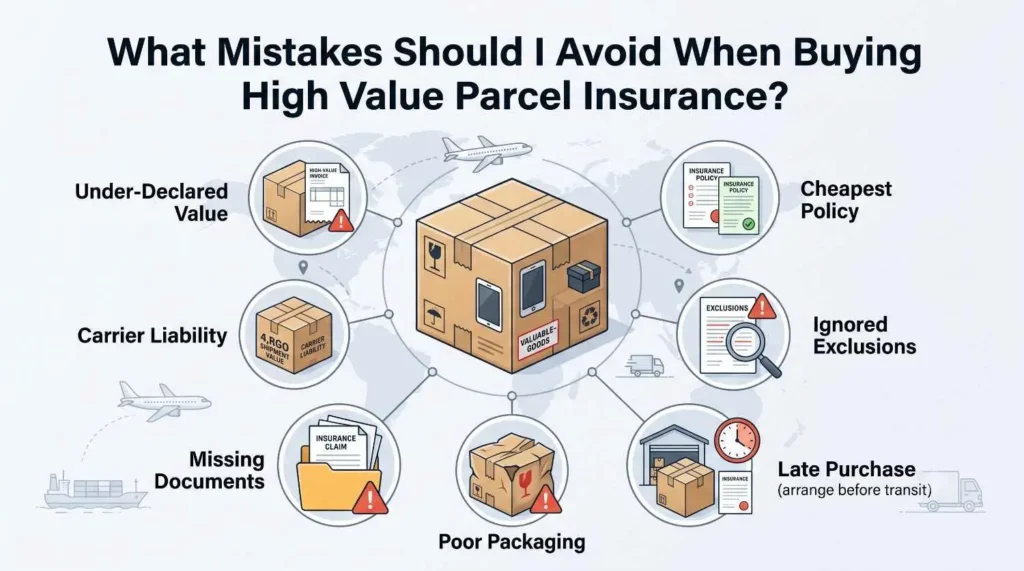
What mistakes should I avoid when buying high value parcel insurance?
Choosing the right High Value Parcel Insurance is just as important as purchasing it. Avoiding these common mistakes can help ensure your shipment is properly protected and reduce the chances of claim disputes.
1):- Under-Declaring the Shipment Value
Declaring a lower value to reduce premiums may result in lower claim payouts if your shipment is lost or damaged. Always declare the actual value of your goods.
2):- Choosing the Cheapest Policy
A low-cost policy may offer limited parcel insurance coverage or higher deductibles. Compare the coverage, exclusions, and claim process instead of focusing only on price.
3):- Ignoring Policy Exclusions
Every insurance policy has exclusions. Read the terms carefully to understand what is and isn’t covered before purchasing your policy.
4):- Delaying the Insurance Purchase
Most insurers require coverage to be arranged before the shipment enters transit. If you buy insurance after your products are shipped, they might not be covered.
5):- Poor Packaging
Even with high value parcel insurance, claims may be affected if goods are not packed according to the carrier’s or insurer’s packaging requirements.
6):- Missing Supporting Documents
Keep invoices, shipping receipts, packing lists, and photos of the shipment. Proper documentation helps streamline the claims process if an incident occurs.
7):- Assuming Carrier Liability Is Enough
Courier companies often provide limited compensation that may not reflect the true value of expensive goods. A dedicated parcel insurance plan offers broader financial protection for high-value shipments.
How Do You Choose the Right High Value Parcel Insurance Provider?
Choosing the right high value parcel insurance provider is just as important as selecting the right coverage. A reliable insurer should offer comprehensive protection, transparent policy terms, and responsive claims support to help safeguard your valuable shipments.
When comparing providers, consider the following:
- Comprehensive Coverage: Choose a policy that protects against common transit risks such as loss, theft, and accidental damage.
- Fast and Simple Claims Process: Look for insurers with a straightforward claims procedure and timely claim settlements.
- Transparent Policy Terms: Review coverage limits, exclusions, deductibles, and claim requirements before purchasing.
- Flexible Coverage Options: Choose a supplier that provides coverage according to the kind of goods, delivery method, and value of your shipment.
- Digital Policy Issuance: Online quotes and instant policy certificates can help save time, especially for urgent shipments.
- International Shipping Expertise: If you ship across borders, choose an insurer experienced in international parcel insurance and global logistics.
- Responsive Customer Support: Reliable assistance before, during, and after shipment can make the insurance process much smoother.
The right provider should do more than offer competitive pricing. They should give you confidence that your valuable goods are protected throughout their journey and provide dependable support if you ever need to make a claim.
Why Choose CargoInsurePro for High Value Parcel Insurance?
CargoInsurePro helps businesses arrange high value parcel insurance and other cargo insurance solutions for shipments moving across international markets. As a MAS-licensed insurance broker, CargoInsurePro works with A-rated underwriters and supports cargo insurance across 150+ countries.
For valuable parcel shipments, relevant features include:
- Multiple transport options: Coverage solutions can be arranged for air, sea, land, and multimodal transportation, depending on the shipment and policy.
- Flexible policy options: Businesses can consider single-voyage, annual, or open-cover arrangements based on their shipping requirements.
- International coverage: Cargo insurance solutions are available for shipments involving markets across Southeast Asia, the Middle East, and other international destinations.
- A-rated underwriters: CargoInsurePro works with established A-rated insurance underwriters for cargo protection.
- Claims support: The team provides assistance throughout the claims process, including 24/7 claims support.
- Policy issuance: Once the required shipment details are received and underwriting is completed, policies can be issued within 24 hours.
For a valuable parcel, the exact coverage, premium, limits, exclusions, and eligibility depend on the shipment and policy terms. Providing accurate cargo and route information allows the appropriate coverage to be assessed before dispatch.
Also Read: Pharmaceutical Transportation Insurance: Protecting Medicines During Transit