

Introduction
As trade and logistics activity grows, businesses in India need reliable ways to protect goods against risks such as damage, theft, and loss during transit. Marine Cargo Insurance in India helps businesses manage these financial risks for covered events.
The Indian maritime cargo insurance market was valued at USD 2.19 billion in 2025 and is projected to reach USD 2.89 billion in 2026 and USD 3.92 billion by 2032, growing at a projected 5.21% CAGR.
Marine Cargo Insurance Rates in India are not fixed. Premiums can vary based on cargo type and value, shipping route, transport mode, coverage, packaging, and overall risk.
This guide explains how marine cargo insurance rates are calculated, what affects premiums, typical rate ranges, and how to compare quotes for suitable coverage at a reasonable cost.
What Are Marine Cargo Insurance Rates in India?
Marine cargo insurance rates in India refer to the percentage or pricing basis used by an insurer to calculate the premium for protecting goods during transit. There is no universal rate that applies to every shipment because insurers assess each cargo risk differently.
A basic premium calculation can be expressed as:
Marine Cargo Insurance Premium = Insured Value × Applicable Insurance Rate
For example, if a shipment has an insured value of ₹10,00,000 and the applicable rate is 0.20%, the base premium would be:
₹10,00,000 × 0.20% = ₹2,000
This is only an illustration of how percentage-based pricing works. The actual premium may vary based on the insurer’s underwriting assessment, selected coverage, policy conditions, applicable taxes, minimum premiums, deductibles, and other terms.
What Does the Marine Cargo Insurance Rate Percentage Mean?
The marine cargo insurance rate percentage represents the rate applied to the value being insured to determine the premium. For instance, a rate of 0.20% means the insurer applies 0.20% to the relevant insured value, subject to the policy terms.
However, businesses should not compare rates in isolation. Two insurers may offer different percentages because their coverage, exclusions, deductibles, limits, or underwriting conditions differ.
Why Isn’t There One Standard Marine Cargo Insurance Rate?
Marine cargo insurance involves different levels of risk. A shipment of durable goods travelling on a straightforward route may present a different risk from fragile, high-value, or specialized cargo travelling through multiple locations.
Insurers may consider factors such as:
- Cargo type: Fragile, perishable, high-value, or specialized goods can require different risk assessments.
- Shipment value: Higher-value cargo creates greater potential exposure for the insurer.
- Route: The origin, destination, transit points, and route conditions can influence risk.
- Transport mode: Sea, air, road, rail, or multimodal transportation can have different risk profiles.
- Coverage selected: Broader protection can result in a higher premium than more limited coverage.
- Packaging: Strong and appropriate packaging can help reduce the likelihood of transit damage.
- Claims history: Previous losses and claims may be considered during underwriting.
This is why businesses looking for the best marine cargo insurance rates in India should provide complete shipment information and compare the overall marine insurance policy value rather than selecting a quote based only on the lowest percentage.
What Are the Typical Marine Cargo Insurance Rate Ranges in India?
Marine cargo insurance rates can vary significantly depending on the cargo’s risk profile, coverage, route, and insured value. Indicative market references commonly show lower percentages for relatively low-risk goods and higher rates for fragile, hazardous, or otherwise high-risk cargo.
Insurance pricing is generally based on the value being insured. Depending on the policy and valuation method, this can include the invoice value, freight, and an agreed additional margin. The exact valuation basis should always be confirmed with the insurer before calculating the premium.
The following ranges should be treated as illustrative rather than fixed Indian market rates:
Cargo / Risk Profile | Indicative Rate Range | Typical Considerations |
Low-risk cargo | 0.05%–0.15% | Bulk non-perishables, general industrial goods and relatively stable cargo |
General cargo / broader coverage | 0.10%–0.30% | Standard commercial goods requiring broader transit protection |
High-risk or fragile cargo | 1%–5%+ | Certain hazardous goods, fragile products, electronics and cargo with higher loss exposure |
These ranges are useful for understanding how risk can influence the marine cargo insurance premium rate, but they should not be treated as a quote. Actual pricing can be lower or higher depending on the insurer’s underwriting assessment and the specific policy.
How Do These Rates Affect the Premium?
Consider a shipment with an insured value of ₹20 lakh.
At an illustrative rate of 0.10%, the base premium would be:
₹20,00,000 × 0.10% = ₹2,000
At 0.30%, the calculation would be:
₹20,00,000 × 0.30% = ₹6,000
This shows why even a small change in the marine cargo insurance rate percentage can affect the final premium when shipment values are large.
For higher-risk cargo, the difference can be much greater. A business should therefore avoid comparing policies based only on the percentage quoted. The coverage scope, exclusions, deductible, insured value, policy limits, and claim conditions should also be reviewed.
Why Can the Same Cargo Have Different Insurance Rates?
There is no universal marine cargo insurance premium rate that applies to every shipment. Two businesses transporting similar goods may receive different quotes because their risk profiles differ.
For example, an electronics shipment worth ₹20 lakh travelling on a well-established route with strong protective packaging may be assessed differently from the same value of electronics travelling through multiple transit points with greater handling exposure.
Similarly, a business with frequent previous claims may receive different underwriting terms from a business with a stronger loss history.
How Can You Get Affordable Marine Cargo Insurance in India?
Getting affordable marine cargo insurance is not simply about choosing the lowest premium. The better approach is to understand your shipping risks, compare suitable policies, and choose coverage that provides adequate protection at a reasonable cost.
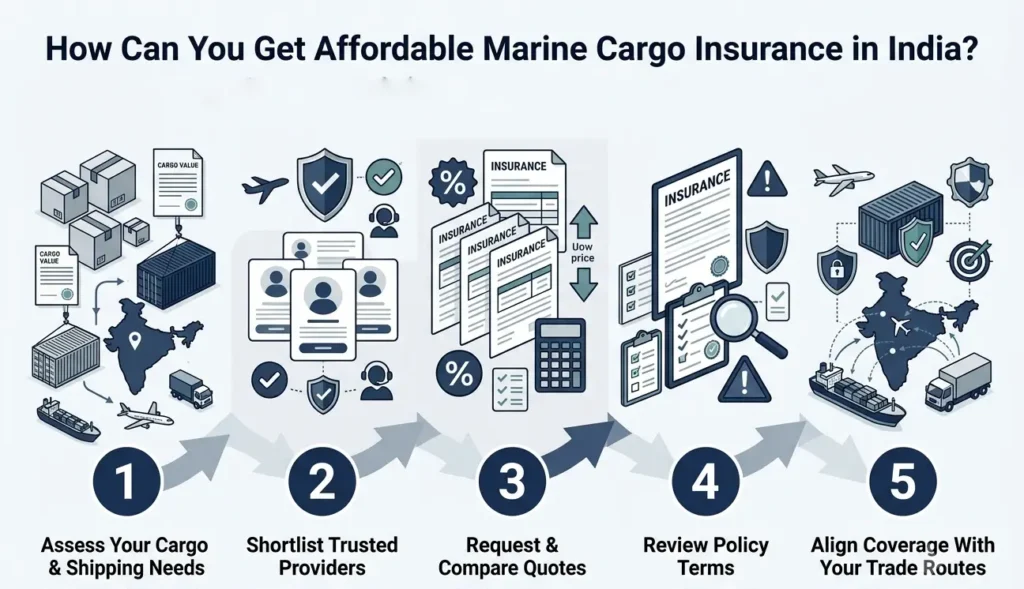
Follow these five steps to find a suitable marine cargo insurance policy in India.
Step 1:- Assess Your Cargo and Shipping Needs
Start by identifying what you are shipping, its value, how often you ship, and the routes involved. Also consider the mode of transport, such as sea, air, road, or multimodal transport.
This information helps you determine the level of marine cargo insurance coverage your business actually needs and gives insurers the details required to assess your risk.
Step 2:- Shortlist Trusted Providers
Look for insurers or insurance providers with experience in marine cargo coverage and a clear claims process. Check whether their policies support the type of cargo, routes, and transportation methods used by your business.
Do not judge a provider by premium rates alone. Policy terms and claims support are equally important.
Step 3:- Request and Compare Quotes
Request quotes from more than one provider using the same shipment details. This makes it easier to compare the marine cargo insurance premium rate, total premium, coverage, exclusions, and deductibles.
A lower percentage does not always mean a better deal if the policy provides narrower coverage or has higher out-of-pocket costs.
Step 4:- Review Terms Carefully Before Signing
Before making a choice, carefully read the policy’s wording. Pay particular attention to:
- Covered risks
- Exclusions
- Deductibles
- Coverage limits
- Valuation conditions
- Claim notification requirements
- Required claim documents
Understanding these terms can help you avoid problems during the marine cargo insurance claim process.
Step 5:- Align Insurance with Trade Routes and Business Goals
Choose coverage that reflects how your business actually ships goods. A policy suitable for regular sea freight may not provide the same terms or risk assessment for air cargo, road transport, or multimodal shipments.
Review your insurance requirements whenever your cargo type, shipping routes, shipment values, or transportation methods change.
Factors That Affect Marine Cargo Insurance Rates in India
The cost of marine insurance is not fixed—it changes based on several risk and shipment-related factors. Understanding these helps businesses estimate their marine cargo insurance cost more accurately and choose the right policy.
1):- Type of Goods Being Transported
High-value, fragile, or hazardous goods usually attract higher marine cargo insurance premium rates because the risk of damage or loss is greater.
2):- Cargo Value and Shipment Size
The higher the value of your shipment, the higher the marine cargo insurance rate. Large shipments may also influence the overall premium depending on risk exposure.
3):- Shipping Route and Destination
Routes that pass through high-risk zones, long distances, or unstable regions may increase Marine Cargo Insurance Rates in India due to higher chances of delays or losses.
4):- Mode of Transportation
- Sea freight: Generally moderate risk and cost
- Air freight: Higher cost due to valuable or urgent cargo
- Road transport: Depends on distance and road safety conditions
5):- Packaging Quality and Risk Handling
Proper packaging reduces damage risks and can help lower marine cargo insurance premium rate percentages.
6):- Claims History of the Business
Businesses with frequent claims may face higher premiums, while a clean track record can help reduce marine cargo insurance rates over time.
Tips to Reduce Marine Cargo Insurance Costs
Reducing your marine cargo insurance cost is possible if you manage risk smartly and choose your policy carefully. These simple tips can help you get better Marine Cargo Insurance Rates in India without compromising on protection.
1):- Maintain Proper Shipping Records
Keep clear documentation of all shipments, including invoices, packaging details, and delivery records. This helps build trust with insurers and can support better marine cargo insurance premium rates over time.
2):- Use Secure Logistics Partners
Working with reliable shipping and logistics companies reduces the risk of damage or loss. Lower risk often means more favorable marine cargo insurance rate percentages.
3):- Reduce Transit Risks
Improve packaging quality, use proper handling methods, and choose safer routes whenever possible. These small steps can significantly lower your marine cargo insurance cost.
4):- Review Insurance Policies Regularly
Business needs change over time. Reviewing your marine cargo insurance policy regularly ensures you are not overpaying and are still getting the best coverage for your current shipping needs.
What Mistakes Should You Avoid When Buying Marine Cargo Insurance?
Common mistakes include choosing a policy based only on price, overlooking exclusions, underinsuring the shipment, and waiting too long to arrange coverage. Avoiding these errors can help you control your marine cargo insurance cost while maintaining suitable protection.
1. Choosing the Cheapest Rate Only
Better value is not always indicated by a low premium. A cheaper policy may have narrower coverage, higher deductibles, lower limits, or more exclusions.
Compare the complete policy before deciding.
2. Ignoring Policy Exclusions
Do not assume every type of loss is covered. Carefully review exclusions and conditions related to packing, inherent defects, delays, storage, handling, and other specific risks.
Knowing what is not covered is just as important as knowing what is covered.
3. Underinsuring Your Cargo
Declaring a value below the actual exposure simply to reduce the premium can leave your business financially vulnerable after a loss.
Make sure the insured value is appropriate for the shipment and follows the insurer’s valuation requirements.
4. Overlooking the Deductible
A policy with a low marine cargo insurance premium may have a higher deductible. Check how much you would have to bear yourself if an eligible claim occurs.
Compare the premium and deductible together rather than looking at the rate alone.
5. Not Checking the Claim Process
Before purchasing, understand how claims must be reported and what supporting documents may be required. Delays in notification or missing documentation can create unnecessary complications during a claim.
6. Waiting Until the Shipment Is Already in Transit
Arrange insurance before the relevant transit begins and confirm when coverage becomes effective. Waiting until goods are already moving may create coverage limitations or leave part of the journey uninsured, depending on the policy terms.
7. Providing Inaccurate Shipment Information
Incorrect details about cargo value, type, route, packaging, or transportation can affect underwriting and may create issues if you need to make a claim.
Provide complete and accurate information when requesting a quote and purchasing the policy.
What Are the Benefits of Choosing the Right Marine Cargo Insurance Policy?
Choosing the right marine cargo insurance policy helps protect your shipment against covered transit risks while keeping insurance costs aligned with your actual business needs. The right policy can also make the claims process easier and reduce unexpected financial exposure.
1. Protection Against Covered Transit Risks
A suitable policy can protect your financial interest against covered losses or damage during transit. Depending on the policy terms, this may include risks such as accidental physical damage, theft, loss, or other specified events.
The exact protection depends on the coverage and exclusions in your policy.
2. Better Control Over Insurance Costs
Matching coverage to your cargo, route, and transportation method helps prevent both overinsurance and inadequate coverage.
Instead of paying for unnecessary protection, you can select coverage based on the risks your shipments actually face.
3. Greater Financial Predictability
A major cargo loss can create an unexpected financial burden for an importer, exporter, or trading business. Appropriate insurance transfers eligible risks to the insurer according to the policy terms, helping make potential losses easier to manage.
4. Clearer Claims Handling
Understanding the policy conditions, documentation requirements, and claim notification process before a loss occurs can make the claims process more straightforward.
Keep important shipping documents, invoices, packing details, transport documents, and other relevant records readily available.
5. Coverage That Fits Different Shipping Needs
Businesses may move goods by sea, air, road, rail, or through multiple transport modes. The right policy can be selected according to the nature of the shipment and the risks associated with its transit.
6. Better Protection for High-Value Shipments
The financial impact of a loss increases as shipment value increases. For example, a 0.20% premium on a ₹50 lakh shipment would be ₹10,000 before applicable taxes or other charges, while the potential financial loss from an uninsured event could be substantially higher.
This is why businesses should consider both the premium and the value at risk when deciding how much coverage they need.
Also Read: 10 Common Mistakes to Avoid When Buying Marine Cargo Insurance in India




One Response