

Introduction
What is marine cargo insurance? It is insurance that protects goods against covered physical loss or damage during sea transportation. Depending on the policy, coverage may include risks such as fire, severe weather, vessel accidents, theft, and other insured transit events.
For importers and exporters, a single damaged shipment can create a major financial loss. For example, a business importing $75,000 worth of machinery could face significant replacement costs if the cargo is damaged during transit.
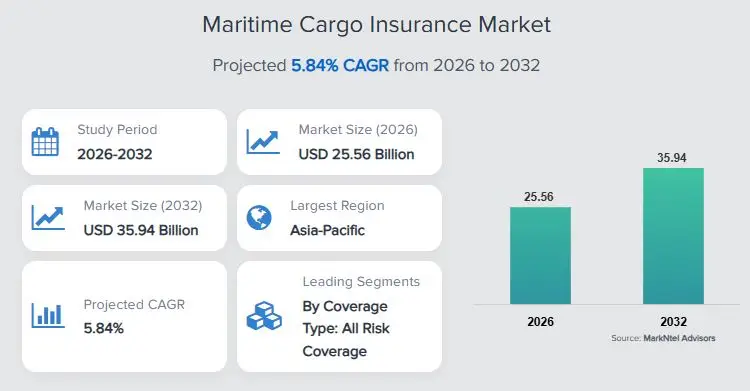
The global maritime cargo insurance market was valued at USD 22.4 billion in 2025 and is projected to reach USD 35.94 billion by 2032, growing at a 5.84% CAGR from 2026 to 2032.
Understanding the right marine cargo insurance policy can help businesses reduce financial exposure during international trade. This guide explains how it works, what it covers, the main policy types, exclusions, costs, claims, and how to choose suitable coverage.
What Is Marine Cargo Insurance?
Marine cargo insurance is coverage that protects goods against covered physical loss or damage while they are being transported by sea. Depending on the policy, it may cover risks such as fire, vessel accidents, theft, rough weather, and other insured events.
For example, if a shipment of machinery is damaged by seawater during a covered transit event, the policy may help reimburse the insured loss, subject to its terms, limits, exclusions, and deductible.
Marine cargo insurance can apply to many types of goods, including:
- Machinery and industrial equipment
- Electronics and consumer products
- Raw materials
- Manufactured goods
- Commercial inventory
The exact marine insurance coverage depends on the policy selected. Some policies provide broader protection, while others cover only specifically listed risks. That is why businesses should review the coverage, exclusions, insured value, and applicable clauses before purchasing a marine cargo insurance policy.
Who Needs Marine Cargo Insurance?
Marine cargo insurance can benefit any business that faces financial risk when goods are transported by sea. It is especially useful for:
- Importers — Protect purchased goods while they are being shipped to the destination.
- Exporters — Reduce the financial impact of damage or loss during international transit.
- Manufacturers and traders — Protect valuable inventory and commercial shipments.
- Freight forwarders and logistics businesses — Help manage cargo-related risks for shipments handled on behalf of customers.
- Businesses shipping high-value goods — Reduce exposure when a single shipment represents a significant financial investment.
The need for coverage depends on the value of the cargo, shipping risks, contract terms, and who is responsible for the goods during transit.
Why Is Marine Cargo Insurance Important?
Marine cargo insurance helps businesses manage the financial risks that can arise when goods are transported by sea. Even with careful planning, cargo can be damaged, lost, or stolen during transit.
Key reasons businesses choose marine cargo insurance include:
- Protects cargo value: Helps reduce the financial impact of covered loss or damage.
- Supports cash flow: A major shipment loss does not have to become an unexpected full business expense.
- Reduces trade risk: Businesses can ship valuable goods with greater financial protection.
- Supports customer commitments: Replacing damaged inventory can help businesses maintain supply and delivery schedules.
- Provides broader protection: Depending on the policy, coverage can extend beyond the limited liability that may apply to carriers.
For example, a company shipping $50,000 of products could face a significant loss if the cargo is damaged by a covered event. With appropriate coverage, the business may be able to recover the insured loss instead of absorbing the entire cost.
The protection available depends on the marine cargo policy, including its coverage, exclusions, limits, deductible, and applicable clauses.
What Does Marine Cargo Insurance Cover?
Marine cargo insurance may protect goods against physical loss or damage caused by covered events during sea transportation. The level of protection depends on the policy, selected clauses, insured value, exclusions, and deductible.
Common risks that may be covered include:
- Rough weather and heavy seas: Storms, high waves, and severe weather can cause containers to shift, fall, or become damaged. Depending on the policy, resulting physical damage to the insured cargo may be covered.
- Fire or explosion: A fire or explosion on a vessel or during an insured part of the transit can damage or destroy cargo. Coverage may apply when the event falls within the policy’s insured risks.
- Theft or pilferage: Cargo can be stolen while moving through ports, terminals, warehouses, or other parts of the insured transit. Some policies may cover theft-related losses, subject to their specific terms and conditions.
- Vessel accidents: Collision, grounding, sinking, capsizing, or other major vessel accidents can cause significant cargo damage or complete loss. Marine cargo insurance may help cover the resulting insured loss.
- Water or seawater damage: Goods can be damaged when seawater enters a container or vessel following an insured event. This can be particularly important for electronics, machinery, textiles, and other water-sensitive products.
- Jettison: In an emergency, cargo may be deliberately thrown overboard to protect the vessel and the remaining cargo. Applicable marine cargo policies may provide coverage for this type of loss.
- General Average: When an extraordinary sacrifice or expense is intentionally made to protect the vessel and cargo from a common danger, cargo owners may have to contribute toward the resulting loss. Appropriate marine cargo coverage may help with an insured General Average contribution.
Important: Not every loss is automatically covered. Businesses should review the policy wording, exclusions, conditions, and applicable Institute Cargo Clauses before assuming a particular risk is insured.
What Does Marine Cargo Insurance Not Cover?
Marine cargo insurance does not automatically cover every loss or damage. Most policies contain exclusions that define situations the insurer will not pay for. These exclusions can vary by policy and coverage level.
Common exclusions may include:
- Inherent vice: Damage caused by the natural characteristics of the goods, such as spoilage, deterioration, rust, or decay, may not be covered.
- Poor packaging: If cargo is damaged because it was inadequately packed, secured, or prepared for normal transportation, the loss may be excluded.
- Delay: Financial losses caused only by late delivery, such as lost sales, production delays, or missed deadlines, are generally not covered unless specifically included.
- War and related risks: War, civil war, terrorism, and similar risks may require separate coverage or an additional clause.
- Strikes and riots: Losses connected to strikes, riots, civil unrest, or other political disturbances may require specific extensions.
- Government action or confiscation: Cargo seized, detained, confiscated, or destroyed by government authorities may fall outside standard coverage.
- Willful misconduct: Losses caused intentionally by the insured or through deliberate wrongdoing are generally excluded.
- Unapproved or undisclosed risks: Cargo, routes, or circumstances that fall outside the agreed policy conditions may not be covered.
Example
A business ships temperature-sensitive goods without proper packaging or temperature control. If the products spoil because of their inherent characteristics or inadequate preparation rather than a covered transit event, the marine cargo insurance claim may be rejected.
Before purchasing a marine cargo insurance policy, businesses should check the exclusions, warranties, deductibles, coverage limits, and applicable clauses. This helps avoid surprises when filing a claim.
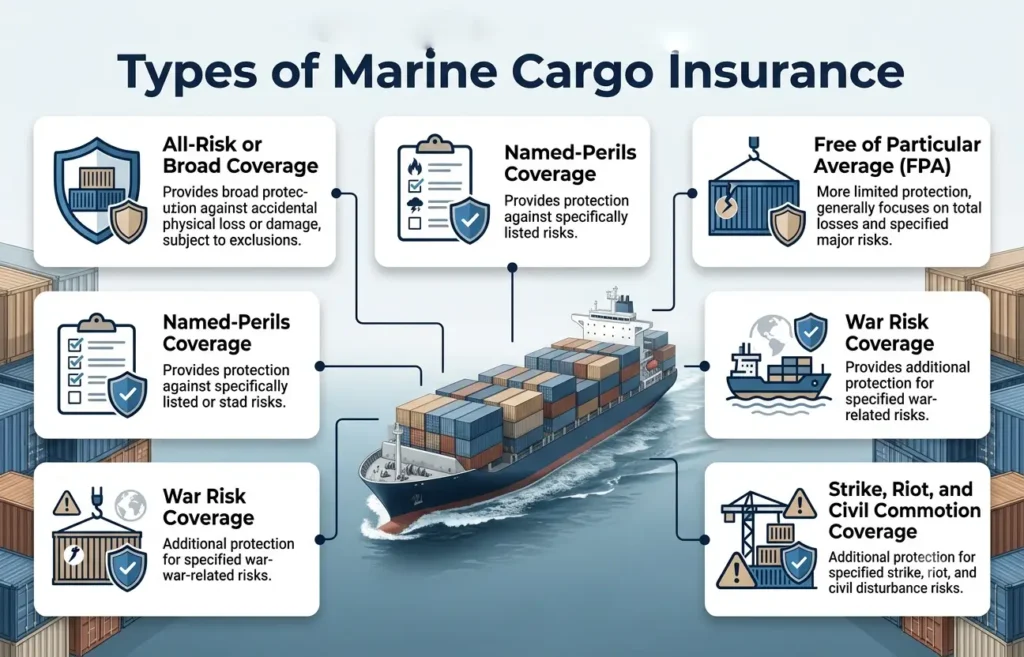
What Are the Types of Marine Cargo Insurance?
The main types of marine cargo insurance differ in the level and scope of protection they provide. The right option depends on the cargo, route, value, and risks involved in the shipment.
1. All-Risk or Broad Coverage
This type generally provides broader protection against accidental physical loss or damage, unless the cause is specifically excluded by the policy.
It can be suitable for businesses shipping valuable or sensitive goods that need wider protection. However, “all-risk” does not mean every possible loss is covered. Exclusions, conditions, deductibles, and policy limits still apply.
2. Named-Perils Coverage
Named-perils coverage protects cargo only against the specific risks listed in the policy.
For example, a policy may cover risks such as fire, vessel sinking, collision, or theft but exclude risks that are not specifically named. This option can be useful when a business wants defined protection against particular hazards.
3. Free of Particular Average (FPA)
FPA coverage generally provides more limited protection than broader cargo policies. Depending on the wording, it may cover total losses and certain partial losses resulting from specified major events.
Because FPA terms can vary, businesses should review the exact policy wording rather than relying only on the name of the coverage.
4. War Risk Coverage
Standard marine cargo insurance may exclude losses caused by war and related risks. War risk insurance can be purchased separately or added through an appropriate extension where available.
It may provide protection against risks associated with war, civil war, hostile acts, or similar events, subject to the specific terms of the policy.
5. Strike, Riot, and Civil Commotion Coverage
Losses arising from strikes, riots, or civil disturbances may also be excluded from standard coverage. A specific extension can provide protection for these risks when included in the policy.
Which Type Should You Choose?
There is no single best marine cargo insurance policy for every shipment. A business should compare:
- Value and type of cargo
- Shipping route and transit conditions
- Coverage limits
- Deductible
- Exclusions
- Applicable Institute Cargo Clauses
- Whether additional war or strike coverage is needed
For example, a company transporting high-value electronics may prefer broader protection, while a business shipping lower-value goods may choose defined coverage for specific risks.
Always check the policy wording before purchasing, because coverage can differ significantly between insurers and policy types.
What Are the Different Types of Marine Insurance Policies?
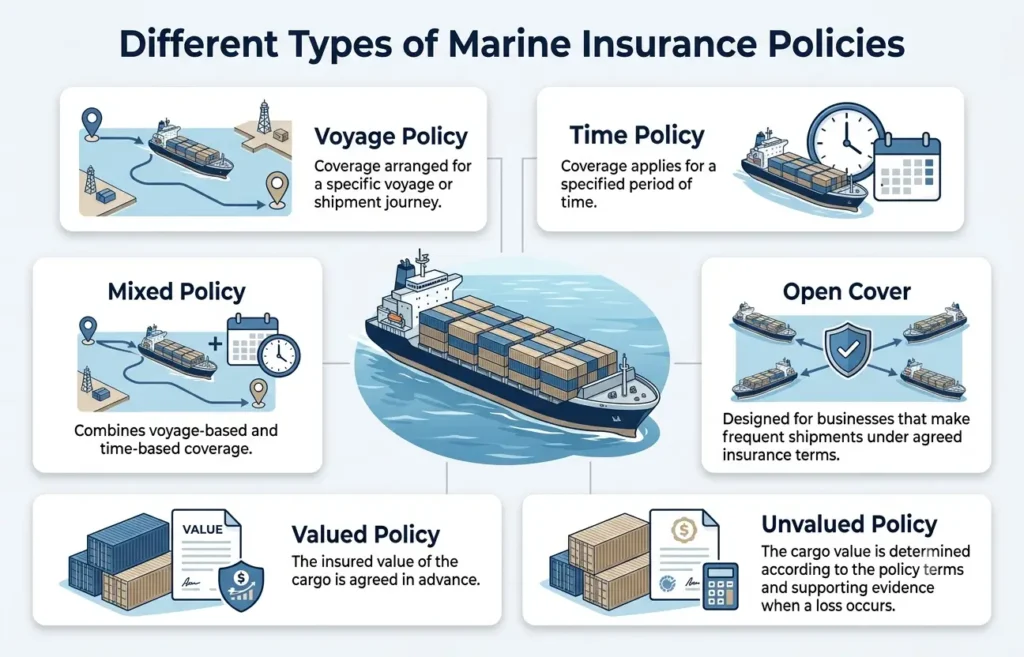
Besides the level of coverage, a marine cargo policy can also be structured according to the duration and nature of the shipment. The main types include voyage, time, mixed, open cover, valued, and unvalued policies.
1. Voyage Policy
A voyage policy provides coverage for a specific shipment or journey, from the agreed point of departure to the destination.
It can be useful for businesses that ship goods occasionally and want insurance for individual consignments rather than ongoing coverage.
2. Time Policy
A time policy provides coverage for a specified period, such as one year. It is more commonly associated with ships and other marine interests, although the exact application depends on the policy.
3. Mixed Policy
A mixed policy combines elements of voyage and time coverage. The policy may cover a particular voyage while also applying for an agreed period, depending on its terms.
4. Open Cover
An open cover is designed for businesses that make regular shipments. Instead of arranging a new policy for every shipment, the business and insurer agree on the general terms under which multiple shipments can be insured.
This can simplify insurance administration for importers, exporters, and trading businesses with frequent cargo movements.
5. Valued Policy
Under a valued policy, the value of the insured cargo is agreed in advance. This can make the claim settlement process more straightforward because the policy establishes the insured value, subject to its terms and conditions.
6. Unvalued Policy
An unvalued policy does not establish the final cargo value in advance. If a covered loss occurs, the value is determined according to the policy terms and applicable evidence.
Which Policy Structure Is Right for You?
The appropriate type of marine insurance policy depends on how often you ship, the value of your goods, and the nature of your business.
Policy Type | Best Suited For |
Voyage policy | One-time or specific shipments |
Time policy | Coverage for an agreed period |
Mixed policy | Combined voyage and time arrangements |
Open cover | Businesses making frequent shipments |
Valued policy | Cargo with an agreed insured value |
Unvalued policy | Shipments where value is determined after a loss |
Important: Policy terminology and availability can vary by insurer and jurisdiction. Always review the actual policy wording to understand what is covered and how the insured value is determined.
What Are ICC A, B, and C in Marine Cargo Insurance?
The Institute Cargo Clauses (ICC) are widely used to define the level of cover available for insured cargo. ICC A, B, and C provide different levels of protection, with ICC A generally offering the broadest cover.
ICC A: Broadest Cover
ICC A provides broad coverage for accidental physical loss or damage to insured cargo, subject to the policy’s exclusions and conditions.
It is often considered when businesses are transporting high-value or vulnerable goods and want wider protection against unexpected transit risks.
ICC B: Wider Named-Perils Cover
ICC B provides protection against a defined list of insured risks. It offers broader protection than ICC C but is narrower than ICC A.
Depending on the wording, covered events can include risks such as fire, explosion, vessel collision, grounding, and certain natural-disaster-related losses.
ICC C: Basic Named-Perils Cover
ICC C provides a more limited level of protection against specifically listed major risks. It can be considered when a business wants basic cargo protection rather than the broader coverage available under ICC A.
ICC A vs. B vs. C
Clause | Coverage Level | General Approach |
ICC A | Broadest | Covers accidental physical loss or damage, subject to exclusions |
ICC B | Medium | Covers a wider list of specifically named risks |
ICC C | Basic | Covers a narrower list of major named risks |
The right clause depends on the cargo value, type of goods, route, risk exposure, contract requirements, and budget. Businesses should also check the specific policy wording because exclusions and conditions can affect the protection available.
Note: ICC A should not be interpreted as meaning “everything is covered.” All three clauses contain exclusions and conditions, and additional coverage may be required for risks such as war or strikes.
How Is Marine Cargo Insurance Different From Other Marine Insurance?
Marine cargo insurance is specifically designed to protect the goods being transported. It is different from insurance that protects the vessel, freight charges, or a transport provider’s legal liability.
Insurance Type | What It Mainly Protects |
Marine cargo insurance | Goods against covered loss or damage during transit |
Freight insurance | Freight or shipping charges that may be at risk following an insured loss |
Carrier liability insurance | The carrier’s legal liability for certain cargo losses or damage |
Hull and machinery insurance | The vessel and its machinery against covered physical damage |
Freight forwarder liability insurance | A forwarder’s liability arising from its services and contractual responsibilities |
Why Does This Difference Matter?
A carrier may have limited liability for damaged or lost cargo under applicable laws, contracts, or transport terms. That liability is not the same as having insurance for the full value of the goods.
For example, if a business ships $100,000 of electronics and the carrier is legally liable for only part of the loss, the business may still face a substantial financial gap. A suitable marine cargo insurance policy can provide separate protection for the insured cargo, subject to its terms, limits, exclusions, and deductible.
Understanding this distinction helps importers and exporters avoid assuming that a carrier’s liability automatically provides full marine insurance coverage for their goods.
How Does Marine Cargo Insurance Work?
Marine cargo insurance works by transferring the financial risk of covered cargo loss or damage from the business to the insurer. The business pays a premium, and the insurer provides coverage according to the agreed policy terms.
The process generally follows these steps:
- Assess the shipment: The business provides details such as cargo type, value, packaging, shipping route, and transportation method.
- Select the coverage: The insurer and business determine the appropriate coverage level, policy limits, deductible, and applicable clauses, such as ICC A, B, or C.
- Pay the premium: The business pays the agreed marine cargo insurance cost to activate the coverage according to the policy conditions.
- Ship the goods: The cargo is transported under the agreed terms and within the policy’s covered transit period and route.
- Report a loss: If the cargo is lost or damaged because of a covered event, the insured should notify the insurer promptly and take reasonable steps to minimize further loss.
- Submit a claim: The business provides supporting documents, which may include the policy, commercial invoice, packing list, bill of lading, photographs, survey reports, and evidence of the loss.
- Claim assessment and settlement: The insurer reviews the circumstances and supporting evidence. If the loss is covered, the claim may be settled according to the policy’s terms, insured value, limits, and deductible.
Example
A company ships $60,000 worth of electronic equipment by sea. During the voyage, the vessel encounters severe weather and part of the cargo is damaged. The business reports the incident, provides the required shipping and loss documents, and files a claim.
If the event is covered by the selected marine cargo policy, the insurer may compensate the eligible loss after assessing the claim and applying the policy terms.
Important: Buying insurance does not guarantee payment for every cargo loss. The outcome of a marine cargo insurance claim depends on the cause of loss, policy coverage, exclusions, conditions, documentation, and applicable limits.
How Much Does Marine Cargo Insurance Cost?
The cost of marine cargo insurance depends on several factors, so there is no single fixed premium for every shipment. Insurers generally assess the value and nature of the cargo, shipping route, coverage level, and overall risk before calculating the premium.
Key factors that can affect marine cargo insurance cost include:
- Cargo value: Higher-value shipments generally require higher coverage limits and may result in a higher premium.
- Type of goods: Fragile, perishable, hazardous, or high-value goods may carry different risk levels.
- Shipping route: Routes with higher exposure to severe weather, congestion, piracy, political instability, or other risks may affect pricing.
- Coverage level: Broader coverage, such as ICC A, can cost more than more limited named-perils coverage.
- Packaging and handling: Proper packaging and safe handling can reduce the likelihood of cargo damage and may influence underwriting.
- Deductible: A higher deductible can sometimes reduce the premium, but it means the insured accepts more of the loss before insurance responds.
- Shipment frequency: Businesses making regular shipments may use an open cover arrangement rather than purchasing separate insurance for every shipment.
For an accurate price, businesses should provide the insurer with complete shipment details and compare the premium, coverage limits, exclusions, deductible, and conditions rather than choosing a policy based on price alone.
Is Marine Cargo Insurance Mandatory?
In many commercial shipments, marine cargo insurance is not automatically required by law. However, insurance may be required by a sales contract, financing arrangement, letter of credit, trade agreement, or specific shipping terms.
One important example is CIF (Cost, Insurance and Freight). Under CIF, the seller generally arranges insurance for the buyer’s benefit according to the applicable Incoterms rules. However, the required level of insurance under CIF does not necessarily mean the cargo has the broadest protection available.
What Should Businesses Check?
Before shipping goods, businesses should confirm:
- Who is responsible for arranging insurance?
- What level of coverage is required by the sales contract?
- What are the applicable Incoterms?
- What is the insured value and coverage limit?
- Are additional risks, such as war or strikes, excluded?
- Who is responsible for filing a claim if the cargo is damaged?
General Average
Businesses should also understand the General Average. If an extraordinary sacrifice or expense is made to protect a vessel and the cargo from a common danger, the parties involved may be required to contribute to the resulting loss.
For example, if part of a vessel’s cargo must be deliberately jettisoned to save the vessel during an emergency, cargo owners may face a General Average contribution. Depending on the policy, appropriate marine cargo coverage may help address an insured contribution.
Important: Legal requirements, contractual obligations, and Incoterms are different from the insurance coverage itself. Businesses should review their sales contract, shipping terms, and marine cargo insurance policy before the shipment begins.
What Happens If You Ship Goods Without Marine Cargo Insurance?
Shipping goods without marine cargo insurance means the business may have to absorb the financial impact of loss or damage that is not recovered from the carrier or another responsible party.
The potential risks include:
- Direct financial loss: If valuable cargo is destroyed or damaged, the business may have to pay for replacement or repair costs.
- Limited carrier compensation: A carrier’s liability may be limited by applicable laws, contracts, or transport terms. It may not equal the full value of the goods.
- Cash-flow pressure: Replacing a large shipment unexpectedly can affect working capital and day-to-day operations.
- Supply disruptions: Damaged or lost inventory may lead to production delays, stock shortages, or missed customer deliveries.
- Additional recovery costs: Businesses may also face expenses related to surveys, salvage, storage, or handling after a loss.
Example
A business ships $80,000 of inventory without cargo insurance. A covered transit incident causes the shipment to be severely damaged. If the carrier’s liability does not cover the full value, the business could be responsible for a significant portion of the remaining loss.
For businesses that regularly transport valuable goods, the potential cost of a single major loss can be much higher than the marine cargo insurance cost of protecting the shipment.
This is why businesses should assess the value of their cargo, transportation risks, contractual responsibilities, and available coverage before deciding to ship uninsured.
What Are the Benefits of Marine Cargo Insurance?
The main benefit of marine cargo insurance is financial protection against covered loss or damage to goods during sea transportation. It can help businesses manage unexpected shipment risks without carrying the entire financial burden themselves.
Key benefits include:
- Financial protection: Helps recover eligible losses when insured cargo is damaged, lost, or destroyed due to a covered event.
- Protection for high-value shipments: Businesses can insure valuable goods such as machinery, electronics, raw materials, and commercial inventory.
- Better risk management: Insurance transfers certain cargo risks to the insurer, helping businesses plan for unexpected events.
- Support for international trade: Appropriate coverage can make it easier for importers and exporters to manage risks across longer and more complex supply chains.
- Protection beyond carrier liability: Cargo insurance can provide separate protection for the insured goods, rather than relying solely on the carrier’s potentially limited liability.
- Greater financial predictability: A known insurance premium can be easier to budget for than an unexpected loss involving a large shipment.
- Flexible coverage options: Businesses can select coverage based on their cargo, route, risk exposure, and contractual requirements, including appropriate ICC clauses or additional extensions.
The value of the protection ultimately depends on the policy’s coverage, exclusions, limits, deductible, and conditions. Insurance should therefore be selected based on the actual risks associated with the shipment rather than price alone.
How Do You Choose the Right Marine Cargo Insurance?
Choosing the right marine cargo insurance policy depends on the value of your goods, the risks involved in transit, and the level of protection your business needs. The cheapest policy is not always the most suitable if important risks are excluded.
Consider these factors before purchasing coverage:
- Assess your cargo: Identify the type, value, fragility, and packaging of the goods. High-value or easily damaged products may require broader protection.
- Review the shipping route: Consider the length of the journey, ports involved, weather conditions, and other transit risks that could affect the cargo.
- Compare coverage levels: Review options such as ICC A, B, and C to understand the difference between broad and named-perils protection.
- Check exclusions: Look for exclusions involving war, strikes, poor packaging, inherent vice, delay, and other risks relevant to your shipment.
- Compare limits and deductibles: Make sure the coverage limit is sufficient for the actual cargo value and understand how much you would pay toward a covered loss.
- Check contract requirements: Review your sales agreement, financing terms, letter of credit, and applicable Incoterms to determine whether specific insurance arrangements are required.
- Consider shipment frequency: Businesses making regular shipments may benefit from an open cover arrangement instead of arranging separate insurance for every shipment.
The goal is to match the marine insurance coverage to your actual exposure, not simply to choose the lowest premium.
How Does Marine Cargo Insurance Fit Into Overall Cargo Protection?
Marine cargo insurance is one part of a broader cargo risk-management strategy. While it protects goods during covered sea transit, businesses may need different types of insurance depending on how and where their goods move.
For example, a shipment may travel by truck to a port, by vessel across the ocean, and then by truck to the final destination. The business should understand which parts of that journey are covered by its marine cargo policy and whether additional transit coverage is needed.
Businesses should also consider:
- Mode of transportation: Coverage requirements may differ for sea, air, road, or multimodal shipments.
- Transit responsibility: Determine when the risk transfers between the buyer, seller, carrier, and other parties.
- Cargo value: Make sure the insured amount is appropriate for the actual financial exposure.
- Policy conditions: Check transit limits, exclusions, deductibles, and notification requirements.
- Carrier liability: Understand what compensation may be available from the carrier and how it differs from cargo insurance.
For a broader explanation of cargo protection, see our guide on What Is Cargo Insurance? A Complete Guide to Types, Benefits, and Business Needs.
Understanding these differences helps businesses avoid coverage gaps and choose protection that matches their complete supply chain.



8 Responses
Can you please help me with your references in APA format
Hi Loide, thank you for your question! This article was written based on our team’s industry expertise and knowledge in marine cargo insurance — it does not reference any specific external source materials.
If you’re looking for more in-depth information, we have a library of free insurance guides and eBooks that cover marine cargo insurance and related topics in detail. You can access them here: https://cargoinsurepro.com/insurance-guides-library/
Hope that helps!